The People Pleasing Project, Vol. 2: Dog-Whistling, Disorganization, Deconstruction

dog-whistling:
"This toxic, narcissistic abuse tactic takes its name from a physical dog whistle, a metal object that makes a sound so high-pitched that only a dog can hear it. The dog understands its meaning, but no one else even hears it." — DR. MELISSA KALT, MD, Recover and Trauma Expert
INDEX:
Dog-Whistling: What It Is & How It Works
Bullying: Bullies Got Bullied
Emotional Abuse Examined 'Down To A Science'
'Show Me The Way': How To SKILLFULLY Combat Gaslighting, Emotional Abuse
A [PEOPLE PLEASER] is someone who possesses an emotional need to please others, often at the expense of their own needs and/or desires.
This is Vol. 2 of The Recess Bell and mentality's People-Pleasing Project — this piece will focus on a particular behavior that people-pleasers can allow to take place and thus continually fall victim to for FAR too long.

Tap here for the introduction to The People-Pleasing Project.
You can read Vol. 1 with the link under the image above. You can also listen to NikiMarie and I's recent podcast episode introducing the People-Pleasing Project to TRB's podcast audience.

Illustration of "dog-whistling," per VOX
I have been blessed to examine and explore a myriad of different mental health topics, conditions, and phenomenons here on The Recess Bell. As I've discussed many times on past "think-pieces" on mentality, I have always carried an intense passion about mental health, psychology, and sociology. Everyone is really just a walking sociology experiment if you really think about it.
While this passion comes from a deep genuine interest in each of these subjects, it also sprouts out from my personal experience with certain phenomenons. I happen to have a vast, almost unconscionable amount of experience with something insidious, calculated, underhanded, and very fucking annoying to deal with: dog-whistling.
Before we dive deeper into what dog-whistling, it's important we define another term: narcissistic abuse.
Narcissistic abuse:
"a form of emotional abuse inflicted by individuals with narcissistic traits or narcissistic personality disorder (NPD). These individuals often exhibit a lack of empathy and a strong need for admiration, leading to manipulative and harmful behaviors. Victims of narcissistic abuse can experience significant emotional and psychological distress, affecting their personal and professional lives." — ELIZABETH KEOHAN, LCSW-C, MSW, Talkspace Council of Mental Health Experts
Let us note that you do not have to be a narcissist (diagnosed with narcissistic personality disorder or NPD) to engage in narcissistic abuse and related behaviors. As NikiMarie and I explained on a past episode of the Mentality Monday podcast, exhibiting narcissistic traits and engaging in narcissistic behaviors does not necessarily deem one a narcissist. It can, however, make you an asshole — no medical diagnosis needed to come to that conclusion.
Back to dog-whistling. I personally don't think it takes a rocket scientist to figure out what dog whistling is under the context of mental health, but let's go through the motions anyway:
Dog-Whistling: What It Is & How It Works
a dog whistle (physically): a whistle used to train dogs, with a very high sound that humans cannot hear

dog-whistling (politically): political messaging that uses coded or subtle language intended to convey a specific message to a targeted subgroup without making the message overtly obvious to the broader public. Often employed to address sensitive topics without explicit statements, dog-whistle politics communicates underlying ideas that resonate with certain audiences, typically aiming to bypass public scrutiny or debate.
obvious example:
"Make America Great Again."

MARIO TAMA / GETTY IMAGES
dog-whistling (PSYCHOLOGICALLY): A form of narcissistic or emotional abuse with the intention to devalue or control loved ones within dysfunctional relationship dynamics. In this case, a person says a seemingly innocuous word or phrase in public and in the presence of the person they wish to devalue. That person, the victim in this case, understands the meaning, but no one else does. — Dr. Melissa Kalt, MD, Recover and Trauma Expert

As Dr. Kalt writes, "dysfunctional relationship dynamics" is where much dog-whistling takes place; at home, at work — I've personally even observed dog-whistling take place on some college campuses, even from professors, supervisors & administrators. HOWARD SCHNAPP / NEWSDAY
Dog-whistling is especially hurtful to victims when you consider the source in most cases. The entire concept of dog-whistling orbits around the idea of someone attempting to harm you — or as Dr. Kalt says, devalue you — with faux-innocuous comments; its real intended meaning containing a message that was meant to land on your psyche. Point being, the vast majority of emotionally abusive dog-whistling comes from the people closest to you; family members, colleagues, and "friends".
It's also a form of gaslighting — another form of emotional abuse that causes victims to question their own feelings, emotions, instincts, and sanity.
psychological manipulation of a person usually over an extended period of time that causes the victim to question the validity of their own thoughts, perception of reality, or memories and typically leads to confusion, loss of confidence and self-esteem, uncertainty of one's emotional or mental stability, and a dependency on the perpetrator
— definition of 'gaslighting' per the Merriam-Webster Dictionary
Bullying: Bullies Got Bullied
"Say the line, Bart!"
All of our tendencies and patterns in adulthood are traced back to our childhood & formative years.

As I always say, it's a fundamental fact of life, but it seems (at least to me) to only get more & more true each and every time I say it these days.

Poor Bart, man.
I was raised in a very traditional household as a kid. For whatever reason, the dynamic at home shook out in such a way where there was very little communication and as a result, even less intimacy.
I intend to create an entire, in-depth project on attachment styles sometime in the near future. For now, I present a brief summary on what they are and how they're relevant to the subject at hand.
There are four attachment styles: secure, anxious-dismissive, avoidant, and disorganized.

4 Attachment Styles Explained — per SOPHRONEO BEHAVIORAL HEALTH
Out of these 4. I just so happened to develop into the rarest (and most complicated) attachment style of them all: disorganized, or avoidant-fearful. Lucky me!
Young children develop into these attachment styles based on the style of care from their parents in the home, as well the nature of their relationships outside of the home (i.e, school).
I mentioned the lack of intimacy that I received during my upbringing at home; unfortunately (and predictably) that didn't parlay into much success fostering relationships outside of the home,
I also feel that in a way, this made me more prone to being a victim of bullying as a child.
Bullying is when people use words or actions on purpose to hurt an individual or a group, either physically, socially, psychologically... They repeat this behavior again and again. They usually want to make the person or group feel less powerful or helpless.
There are different reasons why people bully, including:
wanting to control others and improve their social status
having low self-esteem and wanting to feel better about themselves
having a lack of guilt and awareness or failing to see their behaviour as a problem
feeling angry, frustrated or jealous
struggling socially
being the victim of bullying themselves — per Healthdirect (Australia)

I always found it funny how TV shows would use kids getting stuffed in lockers as one of the central depictions of childhood bullying. Has anyone actually ever been stuffed into a locker or seen it happen in person before? Hit me up if so.
As a man who was majorly raised on not giving people a reaction, I never really bothered to "fight back" when encountering bullying. I just endured through it — wasn't gonna get a reaction out of me! Especially when you come to realize how eagerly they're working for it. I regret this to this day.
It is skillful and noble (in a way) to resist giving people reactions when you're aware of that fact that the bully/harasser is fishing for it. At the same time, there's an old phrase that is extremely relevant to this discussion: "what you allow will continue."
This is actually something I've even actively dealt with throughout my adult life. I can count the amount of times a "friend" has come to me with an issue directly over the past several years on both hands... Adversely, for whatever reason, the vast majority of "negative comments" that I've received from friends has been through dog-whistle comments. There seems to be a construct where these people choose to take shots while maintaining plausible deniability to avoid accountability.
There's a certain level of trust that is supposed to exist within friendships. Dog-whistling doesn't shatter that trust, it just taps the glass repeatedly enough to where you get to a point of extreme frustration, anguish, and exasperation. But, hey! Can't get mad! The glass hasn't shattered, has it?
The simple truth is that no one that is truly your "friend" would engage in this behavior with you. If they've begun dog-whistling you, what's the odds that's it's ever going to stop as long as the "friendship" lives? Not only do they make the active choice not to keep it real and honest with you, they revert to the most cowardly method of attempting to bring you down and "knock you down a peg."
Dog-whistling is also extremely common in workplaces. Because more overt methods of bullying can be subject to legal action, co-workers (and even bosses & superiors) often resort to "dog-whistling" as a safer way to get their vitriol off. I have observed work environments where this behavior has consistently been at a blatant level from all angles. The supervisors and staff aren't just enabling the behavior from subordinates, employees, and volunteers — they're the active ringleaders of this culture while their targets are just left to tough it out each day and those who aren't necessarily targets are encouraged to join in on the "fun."
It's fascinating to witness. My personal theory is that these people, like many other adults these days by my observation, for some reason choose to make it EXTREMELY apparent that they never quite mentally left high school, to say it simply. Cliques, power dynamics, smear campaigns and passive-aggressiveness in any & every regard are what drive the culture in these workplaces forward... even in their advanced ages. Again, why did we allow shit like this to become normalized?
I additionally am not here for any "just get over it" or "toughen up" rhetoric. Everybody over the course of their life has heard a comment about themselves or has had an action done to them that's hurt them. That's what bullying is rooted in. Everyone has some kind of understanding on how hurtful bullying can be, and some have been fortunate enough to pick up some tools over the course of their life to be better equipped to handle bullying.
Yet so many that have fallen victim to bullying and abuse become bullies and abusers themselves. I've discussed the idea of "hurt people hurt people" on mentality before; it's a very understandable premise in theory. However, exacting pain onto another when you possess an understanding of the affect it can have on your target speaks to a lack of principles & moral code. Full stop.
Doing things to others that you not only would not want done to you; to take it a step further, doing things to others that YOU KNOW FOR A FACT affected your mental health negatively when you were on the receiving end — it's the weakest thing we do as human beings, and the extent to which this behavior has been normalized is insane to think about.
Back to that "letting shit slide" mentality, though; it's absolutely related to the phenomenon of people-pleasing.
More specifically; it's when people-pleasing behavior becomes one's central trauma response.
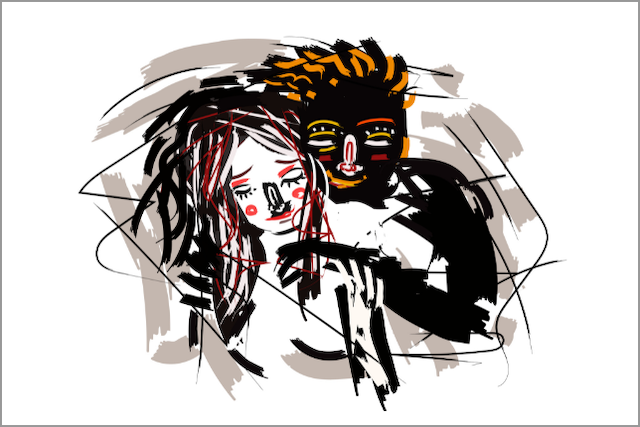
Illustration of emotional abuse — per TINY BUDDHA
Attachment Styles & Experiencing Emotional Abuse
In the Mentality Monday podcast episode embedded at the top of this piece, I discussed being a reformed people-pleaser. Through cognitive-behavioral therapy (CBT) and other positive assets available to myself, I'm proud to say that slowly but surely I am starting to prioritize myself and my mental health much more often than not. But I could not have reached this point without first coming to the realization that the activity of people-pleasing first reared its ugly head in my life as a trauma response.
Disorganized attachment is the most chaotic attachment style, and it's also the attachment style where people-pleasing reigns most supreme.
The ways in which someone with an insecure attachment style goes about accessing connection may differ in that the expectation from others is rejection, disdain, or apathy. With this expectation as a subconscious benchmark of human behavior, avoidant or anxiously attached folks may find themselves going above and beyond to deem themselves “worthy” of connection. — Teyhou Smith, Ph.D, LMFT, Psychology Today
It brings me a lot of shame to admit this, but even in the face of shitty treatment and passive-aggressive gaslighting from friends and close colleagues, I had still attempted to remain friendly, cordial, and, malleable... to keep those bonds intact and to "keep the peace."
Imagine that: while one side incessantly shit-talks, gaslights, and emotionally abuses seemingly without conscience, I represented the other side that would go, in Dr. Smith's words in the quotes above, "above and beyond'' to keep the status quo and "maintain/earn connection."
Aforementioned in this work, dog-whistling is a very calculated and measured method of abuse. Going back to the origins of the term, it's tough to challenge someone on something that isn't fully out in the open. The insults and shots are veiled and undercover. When attempting to check someone's dog-whistle comment, the retorts can sound something like "What did I say?" or "You're reading that deep into it?", which can make you appear like a lunatic... to others and even to yourself. That's gaslighting for you! Amazing what a little bit of reasonable doubt can do.
This is exactly what makes dog-whistling so effective against people-pleasers. It thrives in ambiguity, which is something disorganized attachment is already wired to tolerate and endure.

Somebody say "Reasonable Doubt?"
Yes, people know who they can try. In other words, people generally have a good idea of who/what they can fuck with and largely get away with it.
Knowing this, while also knowing the difficulty in challenging and shutting down this behavior? It begs the question; how does a breaking of the cycle happen?
'Show Me The Way': How To SKILLFULLY Combat Gaslighting, Emotional Abuse
In a recent therapy session, I landed on an incredible realization: while most people, as we've discussed on this platform before, largely take the trauma they've suffered and inflict onto others in a myriad of ways.
But it takes a great amount of self-awareness, social awareness, and willpower to resist that natural inclination and instead choose to use trauma as a learning lesson to move better and think about certain situations more skillfully.
And there has to be a special emphasis on the word "skillfully" here.

"There's a way to do better — find it." - Thomas Edison
If there's any point I want driven home most on this "People-Pleasing Project", it's this: when making the conscious choice to engage in conflict, or conflict resolution, it's extremely important to NOT move and react emotionally within those conversations.
All conflict is rooted in some emotion, that is true. But attacking said conflict with too high an emotional charge can unfortunately make the whole process moot.
If you're someone that's dealt with anger issues in the past, you're likely familiar with this concept. You'll get upset about something, and feel fully justified in that anger based on what the other party has done to you. But because you reacted and behaved explosively within the conversation, your initial issue gets lost and forgotten while the focus now shifts squarely on your outburst.
In my study of what sociologists and psychologists have said on this subject, the common denominator here is that logic & reason can prevail over emotion in the vast majority of situations, and this is especially the case when it comes to attacking interpersonal conflict.
When confronting dog-whistling, it’s important to move skillfully and logically while doing so. While it’s natural to want to completely lash out at the offending party (gaslighting has a way of bringing us to this boiling point over time), it may actually wind up doing more harm than good in the long run.
I mentioned earlier that the “dog-whistlers” can use your loud and aggressive confrontations of their behavior against you by making you seem crazy and/or hostile, which compounds the problem.
Far better reactions would be to:
Calmly and sternly ask for clarification on their comments.
Let the comment pass in the moment, then circle back in a private moment with the offender to discuss the situation.
Trust your gut: acknowledge what’s being done by the offender and simply remove yourself from their company moving forward.
As I am typically “Captain Crashout”, I’m not all the way pleased with these solutions I've typed out. My natural inclination these days is to meet flagrant bullshit with just as flagrant a response. In other words: "when they go low, I go to the gutter."

Unfortunately, I’ve learned many a time that while that approach may be more instantly gratifying in the short term, it's likely to be counterproductive in the long-term. In a roundabout way, it can even make you more of a target for bullying and harassment.
What are bullies typically seeking out of people? A reaction, tied to them using said reaction(s) as a sort of powerful medicine for their own low self-esteem. You could be fueling more aggressive forms of abuse with aggressive rebuffs of the initial actions.
I discussed this on the "The Healing Journey" project here on mentality: while we cannot control what kind(s) of trauma hit us throughout our lives, it is our responsibility to decide how that trauma plays out in our actions and decision-making.
Much of this responsibility lies in the quandary of behavior towards others as a emotionally/mentally traumatized person. Are you taking the easy way out (perpetuating trauma, meeting abuse with easily-provoked, volatile anger) or are you taking the more positive road less traveled, which would be using your trauma as an example of what NOT to do to others and, in the case of attacking conflict, choosing a more mature and measured approach, even while carrying intense frustration.
This is a consistent theme found in every single mental health concept, topic, phenomenon, behavior, or condition that we've explored on TRB. So much difficulty can be solved through detailed, conscious self-evaluation, which leads to increased self-awareness.
Doctors, to put it frankly, can't diagnose shit, nor can they come up with any kind of treatment plan for an injury or illness before they properly evaluate the issue and become aware of what the problem is. I guess you can say we're the doctors of our own psyches? Yes, psychologists and neurologists exist, but my point is that attacking any type of toxicity in our life effectively starts with good self-awareness. Especially when it comes to emotional abuse, gaslighting, and, yes: dog-whistling.