Celebrating Black Creatives: Eureka! The Story of Lewis H. Latimer

as The Recess Bell prepares to kick off our third annual 'Celebrating Black Creatives' campaign as Black History Month approaches, we take a look at one of the more influential and under-discussed Black pioneers in American history and why his legacy is so quietly galvanizing
One of the most universally familiar tropes of all time is the idea bulb. You know, when a fictional character has a great moment of thought and suddenly a light bulb appears and flashes on over their head.

"Eureka!" - Goofy, probably
The idea bulb has been a western animation staple since it first appeared in 1920. As The Recess Bell is the Network for Creatives, to be creative is to constantly conjure up ideas and consistently execute on them.
Regardless of if you're an "established" creative or not, I'm sure you've had your share of idea bulbs. As for the first actual, real life lightbulb? That was invented several decades before then.
Way back in the 1830s, the first iteration of the light bulb was invented. Fast-forward to 1879, and a guy named Thomas Edison patented the first incandescent light bulb (incandescent bulbs are the bulbs the world's used from its invention to present-day).
Edison's first rollout of the bulb had its issues, though. They were too power-consuming, expensive to make and expensive to buy. They only lasted for just over 13 hours before they fizzled out and consumers had to purchase a new one. Not very practical.
Edison continued to work on his project but could only make incremental progress on his own. So he complied a team and made it a collaborative effort. Who would eventually become the star of this newly-assembled group?
An inventor, engineer, pioneer, and black man by the name of Lewis Howard Latimer.

Lewis Howard Latimer (1848-1928)
Before we delve into Latimer's genius, let's first establish this: it doesn't take a rocket scientist to comprehend the depth of systemic obstacles that stood in the way for a black man or woman's attempt to rise to prominence (or just simply survive) during the 1800 & 1900s.
Latimer's plight was no different, as slavery defined his childhood and youth. Through ambition, perseverance, and intelligence, Latimer did the near-impossible during this time; as a black man, he thrived.
Latimer and Edison connected in the 1880s, as Edison hired Latimer away from the U.S. Electric Lighting Company; the rivals to Edison's lab. In the years prior, the race between Edison and U.S. Electric founder Sir Hiram Maxim to perfect the lightbulb was in full effect. It would eventually become known that the key into the future was in Latimer's hands.

The incandescent lightbulb, which Lewis H. Latimer helped make commercial. Incandescent means to emit light through heat, or electricity.
Edison patented the carbonized incandescent lightbulb in 1880; a historic achievement of product. Still, it still had its limitations. It was not until Latimer built on the Edison bulb's carbon thread that Edison's ultimate goal at this time became reality: the creation of a patent lightbulb that could last very long and cost very little to manufacture.
Latimer's "idea bulb" made lightbulbs mass-producible. The ease with which we can purchase packs of lightbulbs and screw them into our lamps? That can all be traced back to Lewis H. Latimer.
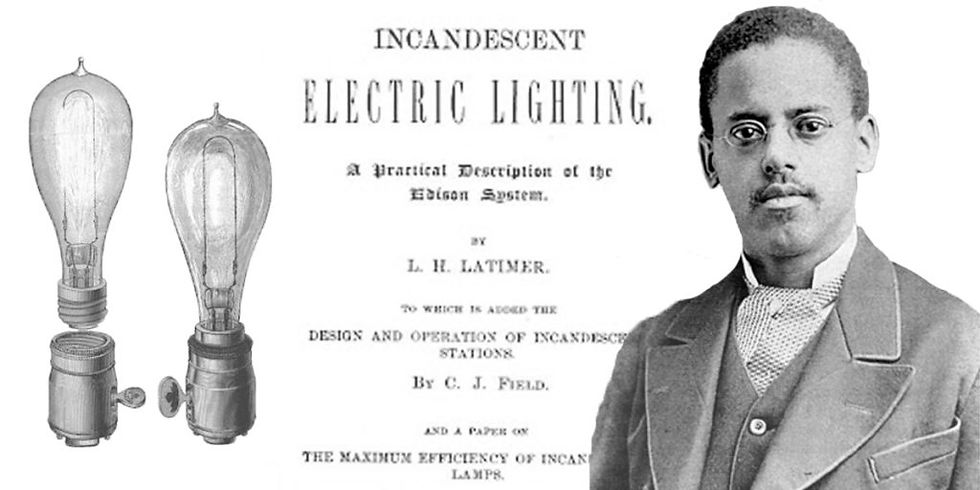
The cover of Lewis H. Latimer's technical book, INCANDESCENT ELECTRIC LIGHTING: A PRACTICAL DESCRIPTION OF THE EDISON SYSTEM, published in 1890.
Latimer and Edison's working relationship only grew from there. In addition to being Edison's central engineer, Latimer served as Edison's patent investigator and crew supervisor.
Historians note how unusual and stunning it was for Edison (as well as Maxim and others) to have empowered a black man to such a degree during this time. But Latimer's intellect was so undeniable that he became a standout at every stop he made throughout his journey.
If you're a Black creative, doesn't this all sound sort of familiar?
Right now, I can hear the words from my elders that rang through my ears on a regular basis throughout my formative years. "To be black and successful in America is to work twice as hard as your colleagues or counterparts for about half of the credit."
No matter how many "DEI" initiatives are torn down and burnt to the ground by this country's current administration, if you research and look at the history of America through an objective lens, you know that Black and brown people have been disadvantaged in several certain ways in several areas, including the workforce and certainly in the creative realm. Racism, in other words.

"If you stick a knife in my back nine inches and pull it out six inches, there's no progress. If you pull it all the way out, that's not progress. Progress is healing the wound that the blow made. And they haven't even pulled the knife out, much less heal the wound." - Malcolm X, 1964
Racism in America isn't immethodical. It's systemic; deeply interwoven into the fabric of our society.
Every time it's seemed like progress is being made to begin to dismantle this system, the prejudicial foundations of the system reign supreme through hard "overcorrections". For most of us, it becomes more and more disheartening each time this takes place.
This is why Black History Month matters so much to me, and why I'm proud to announce The Recess Bell's third annual 'Celebrating Black Creatives' campaign throughout the month of February.

Check out ALL the content from 2024 and 2025's TRB x BHM campaigns by clicking here!
For the third consecutive year, I, Joshua Umahi and my close friend & TRB lieutenant Gina will not only spend the entire month of February paying homage to several Black creatives, pioneers, inventors and influencers of the past, but we look forward to using our platform to shine a light (yes, pun intended) on some of the incredibly talented yet "underground" Black creatives in our direct orbit and beyond.
More than anything else, we look forward to hearing the powerful stories that so many carry in overcoming adversity and deciding to pursue their dreams and passions in unrelenting fashion.
Successful Black entertainers, educators, and innovators have to have a certain level of persistence in them. It's not possible to navigate this world without that quality; it's far easier to give up and quit. There is no perseverance without persistence, of course. I find that to be especially true for the Black creative.

"American mainstream is obsessed with black creative genius - be it music, walk, style - but at the same time puts a low priority on the black social misery which is the very context out of which that creativity flows." — Cornel West, RACE MATTERS (1993 book) • ELIAS WILLIAMS / THE NEW YORKER
To circle back to Lewis H, Latimer: he certainly knew how to persevere. You may already be familiar with what it means to be multidisciplinary — to have multiple talents, purposes and fields of expertise — especially as it pertains to being a creative.
Over the course of the remainder of his life, Latimer had patents approved for other innovations, which include coat racks, book supporters, and lamp fixtures. An author; he wrote his book on incandescent electric lighting pictured earlier in this piece, and also penned a poetry book. He became a teacher in the studies of English and Mechanics. He played multiple instruments and made the time to paint portraits as well. He was a dedicated civil rights activist. He even served in the damn military.
Latimer's legacy is kept alive through multiple structures and monuments in New York City; the city where he passed away in 1928. The most notable of these structures is his preserved family residence that has now been transformed into a museum on 137th St. in Flushing, Queens: The Lewis H. Latimer House.

The incredibly preserved Lewis H. Latimer House: 34-41 137th St. in Flushing, Queens.
To summarize and conclude: the Black creative can draw immense inspiration from Lewis Howard Latimer's life and legacy. We've established that higher levels of excellence are required out of Black people compared to the majority. Latimer consistently met the moment in that regard. As a result, he regularly made himself a mainstay; an indispensable piece in spaces that were not meant for him to succeed.
Yeah, he never received overwhelming acclaim for his collection of transcendent accomplishments. There's a powerful lesson in that too, however. In a click-obsessed, views-obsessed, likes-obsessed, algorithm-obsessed world, Latimer's journey shows us that while the praise is nice to receive, that isn't and shouldn't be the end-all-be-all.
It should instead be the impact and contribution that you make in your craft, because that is what will continue to push our culture forward and inspire not only your peers, but the next generation as well.
---
I look forward to sharing the great stories of the many Black creatives we'll be platforming over the next month. If you'd like to be a part of the 2026 'Celebrating Black Creatives' campaign, please do not hesitate to reach out to us!
You can contact us using the chat feature on the site, and on our social media (search 'therecessbell' on Instagram, TikTok, X, and YouTube, feel free to DM). You can also email us directly at therecessbell@gmail.com.
Remember: all it takes is one idea to make change. I wish the brightest idea bulbs onto you all.


