A House of Cards Will Never Last And Stand

INDEX:
INTRO: THE DANGERS OF A HOUSE OF CARDS
PILLAR 1: INTEGRITY
PILLAR 2: CONSISTENCY
PILLAR 3: ADAPTABILITY
PILLAR 4: TEAM DYNAMICS
CONCLUSION
house of cards (n. phrase, idiom)
a structure, situation, or institution that is insubstantial, shaky, or in constant danger of collapse
a weak plan, system, or organization that is built on a shaky foundation and will easily fall apart
Most people hear the phrase "house of cards" and first think of the political thriller TV series that dominated on Netflix for 5 years before being canceled due to the show's leading man, Kevin Spacey and his... well... legal troubles. There's a whole, entire rabbit hole on that topic if you wish to go down it.

Netflix's HOUSE OF CARDS (2013-2018)
The show was named and adapted after the 1989 "House of Cards" trilogy of novels written by Michael Dobbs, which was set in the United Kingdom and outlined the slimy and sleazy tactics that central character Francis Urquhart resorted to in his goal to become the Prime Minister of the United Kingdom; the most powerful of the powerful.
A House Of Cards: if all goes according to plan, the ends justify the means. In other words, whatever manipulative and immoral tactics taken to reach the top are considered well worth it, since the top was reached. However, if these maneuvers were to ever be found out, especially by the public, the whole entire operation could come crashing down as quickly as a flash of light.
The successful 'House of Cards' TV series was based off of the book trilogy penned by Michael Dobbs, who has quite the legacy in the United Kingdom.
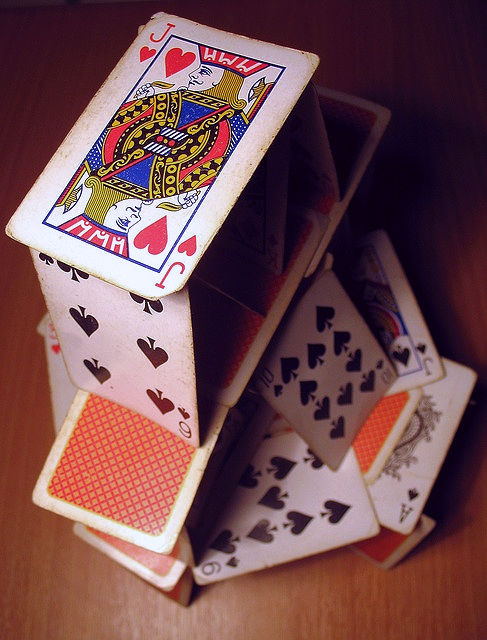
If you've ever built a "house of cards" from an actual playing deck of cards, you know how impressive the final product can look. Each card carefully and strategically placed from top to bottom, left to right, forward and backward. However, as it was built using nothing but a deck full of flimsy, frail paper cards, one little mistake; an abrupt flick of a finger, a quick breeze of wind, and down goes it all.
This is where we arrive at the very reason I pen this piece today. In the creative realm, many things get built. Plans get drawn out, art gets produced, and teams get formed. With this, if there's any word of advice I could give to every single creative walking the planet right now (including myself), whether that's a "rookie" creative planning out their first-ever event or a famed artist on the same ranks of a Kanye West, Zendaya or Timothee Chalamet, it's this:
Make sure whatever it is you create is built with strong roots in the ground and a sturdy foundation, because whatever it is you develop, no matter how outstanding, great or unprecedented it is: it will eventually come crumbling down if the foundation is flimsy or anything short of firm.

Impressive, but not built to last.
These words of advice can apply to just about any walk of life. But as The Recess Bell is the Network for Creatives, I find this especially important for the life and career of a creative. There's very little that's more heartbreaking than pouring your entire soul into something only to realize that the foundation that it was all built on wasn't at all strong enough to stand the test of time.
To avoid this fate, I've identified 4 major pillars to take your work from a fragile house of cards to an impenetrable, unshakable fortress.
Pillar #1: INTEGRITY
(n) firm adherence to a code of especially moral or artistic values : INCORRUPTIBILITY
Let's say you want to be a creative writer as a career. You have all the innate tools needed to succeed on this path, and the people around you know it.
But talent doesn't always translate directly to prosperity. You weren't prepared for just how much work being a truly great writer entails. The days and weeks spent drafting and scrapping concepts back and forth. The coming-and-going instances of writer's block.
Here, you have a choice. You can choose to power through the challenges of what it requires to be authentically great... or you can choose instead to skip steps.
"Skipping steps" here would include plagiarizing other people's work. But the big elephant in the room here is ChatGPT.

ChatGPT was launched by OpenAI CEO Sam Altman quietly in 2022; it has since exploded into a major figure in the growing world of tech, to many''s dismay.
Why waste time grinding when you can type a prompt into ChatGPT and produce each chapter for your novel that way? I'm sure a good number of aspiring writers have unfortunately fallen into this trap.
The obvious issue here is that while some of your favorite famed writers paved the way for you without the wealth of technological advantage at our disposal today, and while some of your peers are doing it "the hard way" without the use of AI chatbots, you meanwhile are cutting corners. And while this might not be a crime, it's definitely far from moral when you consider everything that we've just outlined here.
Want another example? I'll keep this one simple. Those crusty-looking AI-generated flyers that suddenly popped up EVERYWHERE; from your Instagram timelines to YouTube thumbnails and even out in front of your local restaurants and bars? Yeah, those are the definition of what it means to skip steps.

Case in point.
I don't mean to be preachy, just working towards my point here. Skipping steps lacks integrity, and where there is a lack of integrity in creation, you probably have less of a "creation" and more of a house of cards. Flimsy, lacks actual substance, and will come crashing down at any moment because it wasn't built on the back of actual skills and hard work; it was built on shortcuts.
Even while the world we live in seems to have less and less integrity in it by the day, I urge you to not be fooled. All these powerful institutions run by billionaires that amass more and more power off the backs of the unsuspecting or otherwise helpless public? They may look untouchable now, but I truly mean what I'm saying here: it's all smoke and mirrors. Things built on integrity and good values last. Things that run on corrupt and insincere dealings may have their periods of prosperity, but they'll come crashing down eventually. They always do. Some take more time to crumble than others, but trust and believe: they will crumble.
The same properties apply to a creative's work. Try not to get so caught up in people's opinions of your work. Work that is filled with integrity in creation might take longer to "go viral". Integrity means taking more time to create because it doesn't involve taking shortcuts or cheapening your work to gain more instant gratification. For those that are chasing instant gratification by cheapening their work will only have a short time under the sun. Because houses of cards are destined to fall.
Pillar #2: CONSISTENCY
(n) the quality of always behaving or performing in a similar way
Let's take a sharp turn to the sports world here. In the NBA, the New York Knicks shocked the world by winning the 2026 championship and ending the city's 53-year professional basketball title drought. Leading the way for the Knicks in this great accomplishment was the team's All-Star point guard and captain, Jalen Brunson. I've written about this guy multiple times on this platform already. As a diehard Knicks fan, he's essentially a deity to me and hundreds of thousands of New Yorkers. It is what it is.
In this piece, however: I point the spotlight at his father, Rick.
NBA Champion Jalen Brunson's rise to success was largely influenced by his father Rick and his intense training of Jalen as a young boy.
In watching Jalen play for my Knicks, I had always wondered how he became such a consistent superstar, given how he's not the biggest, fastest, or most muscular guy by any means. After some digging, it became clear that the answer lied in how Rick raised him.
Rick's basketball training of a young Jalen may have bordered on child abuse, yeah. I can admit that. But a key to crafting a champion is building good habits that last. And a great way to do that is through repetition; relentless repetition, in Rick and Jalen's case.
My point: a lot of people can do something great once. Maybe even twice. But without the requisite consistent habits for sustainability, you will fade eventually. The whole idea of a "one-hit wonder" revolves around this idea. Sheer talent can get a musical artist one hit record. The work ethic that follows will largely determine whether more hits come after that or not.
No consistency, no longevity. No longevity, very little probability of your long-term creative dreams being realized. Your habits have to breed your results. Having it the other way around will ensure the collapse of your house of cards in due time.
Pillar #3: ADAPTABILITY
(n) an ability or willingness to change in order to suit different conditions
Building off of my earlier mention of the Knicks' championship (I can't help myself), I've seen many basketball fans flabbergasted at how the Knicks wound up going on a historically-dominant run through the playoffs. Similar to Jalen Brunson's dynamic in relation to the rest of the NBA, the Knicks weren't the most talent-rich team out there. They didn't boast a collection of 3-to-4 All-Stars, nor did they have a generational superstar the likes of whom they defeated in the Finals: the Spurs' Victor Wembanyama.
The Knicks' secret weapon was their versatility. For the purpose of the piece, let's call it their "adaptability."
They could beat you playing big, or they could beat you playing with a lineup full of smaller, quicker guys. They could beat you in a defensive slugfest, or they could beat you in a fast-paced, high-scoring shootout. They could beat you playing a rotation of 7 guys or with a much larger rotation of 10-12 guys seeing the floor. The best coaches throughout sports today have figured this out: you have to build a shapeshifter of a team that can do whatever is required on any given day to best increase your probability to win... and win big.
As I often call sports the ultimate metaphor to life, I can't stress enough how important adaptability is for anyone chasing sustained success in their life. We live in an ever-changing, evolving world that forces us to change along with it. The world's greatest innovators didn't reach unforeseen heights by always going with the flow and building their next creation off of what everyone else was already doing. They had to be forward-thinking in what the world might need in the future.
Even in the typical "9-to-5 career" sense, you probably have to be good at more than one thing within your job to have real staying power. Considering the state of the economy in America today, you have to find a way to be good at a bevy of things because your lifestyle might require you to work multiple jobs.
The same concept applies for the creative. For as unpredictable as life can be for a "nine-to-fiver", it is even more unpredictable for the creative relying on their creative skills to fund their life. Maybe at one point in time, being excellent at one thing was enough to get by. Today, due to the (unfortunate) rise of AI, graphic designers, for example, have been forced to adapt and find new ways to stand out and get noticed. Thankfully, this isn't an impossible task.
The fact still remains, though. If you aren't versatile and adaptable in your approach, especially in today's day and age, you're more than likely going to wind up with a big-ass house of cards that could crash down at any moment. Being adaptable wins in the NBA, and it wins away from the basketball court as well.
Pillar #4: TEAM DYNAMICS
(n. phrase) the psychological, behavioral, and social forces that shape how people interact, communicate, and collaborate while working toward a common goal
For my money, one of the greatest books ever written is "The Five Dysfunctions of a Team" by Patrick Lencioni.
In the first three pillars of this piece, we've discussed creatives building sustained success on their own. Here is where we highlight the importance of team dynamics within a creative group. I cannot stress enough how crucial that is. And I speak from personal experience with this.
I know I keep relating everything back to sports, but they really do serve as the perfect reference point for what it takes to build and create a long-term winning product. As I made brief mention of this when discussing the 2nd pillar: successful, award-worthy, "championship" teams are not constructed off of talent alone. Truly healthy and effective team-building requires all of the dynamics mentioned in Lencioni's famed book: solid trust, a culture of sacrifice, constant communication, shared accountability and commitment.
LeBron James, arguably the greatest basketball player to ever walk the planet, recently signed what may likely be his final NBA contract with the Philadelphia 76ers, hopping on as the 42-year-old final piece of a star-studded lineup featuring 3 other All-Stars in the starting lineup with a good amount of depth behind them.
It's an intimidating group on paper, but we've seen this story before across sports. Compiling talent and putting together video-game rosters does not always guarantee the ultimate goal of a championship. It doesn't even guarantee mild success sometimes.
For any team to be great, the team has to be built on a strong foundation worthy of its potential. There's no other way to frame it. If egos go unchecked at the initial stages of the team's formation, that will corrupt the process eventually. If the leadership is faulty, the entire operation will become faulty by.... default. Constant and persistent betrayals of trust that go unaddressed? I'm telling you, the whole ship will sink in due time.
The most beautiful and successful teams and organizations that turn into legacy, standing the test of time for generations: that doesn't take place by accident. Yes, a little luck is required, as is the case with anything in life. But above all else, it took COLLECTIVE work and an EQUAL thirst for achieving that shared and established goal.
On the most basic level, this isn't just true for creative groups, but it's true for families and friend groups as well. Continually sweeping issues under the rug for the sake of "keeping the peace" or "avoiding drama" is simply putting a band-aid over a tumor. The problems are only going to grow until they can't be avoided anymore. And if that lack of shared accountability continues at this inevitable reckoning point, the dynamic is cooked beyond repair.
“Great teams do not hold back with one another. They are unafraid to air their dirty laundry. They admit their mistakes, their weaknesses, and their concerns without fear of reprisal."
― Patrick Lencioni, The Five Dysfunctions of a Team

Poor morals and values within the group will corrode the group's future more than anything else as well. A reliable moral code and solid value system is super-important for an individual; that makes it even more vital within a group setting.
If a large building's foundation is only held together by some of the bolts and not all of them, they're much likelier to collapse under even the smallest points of stress. Similar to — you guessed it: a house of cards.
YOU GET THE GIST; LET'S WRAP THIS UP
It's understandable to feel like life (especially today) should be a lot easier than it is. A descending economy, a piss-poor job market and a decreasing reliance in the workforce on skills in favor of AI can serve as a recipe for disaster for the common creative. If you're a creative reading this, I will again urge you to stay the course and remember how to build a life, a legacy, and a movement that is able to last and won't just get you through the current time, only to fizzle out later on.
Cutting corners, skipping steps, and opting for shortcuts to improve your present is only quietly eating away at the potential of your future. Instead, use these pillars to fortify your foundation; you'll always have that to fall back on under moments of stress and strife.
If you insist on taking the easy ways out, though: down your house of cards will go, eventually. There is a huge amount of evidence of this taking place throughout history, both on the large-scale and smaller, interpersonal scales — probably even throughout your own life. Don't ignore it.